Transforming Education with Strategic Classroom Social Media Templates
In an era where digital literacy is as fundamental as reading and writing, educators face a constant challenge: how to bridge the gap between the digital native's world and the academic curriculum. The solution lies not in banning technology from the classroom, but in harnessing its engagement power for pedagogical gain. Social Media Templates for Classroom use are more than just a novelty; they are a sophisticated instructional tool that leverages the visual language of platforms like Instagram to deepen understanding and foster creativity. When implemented with clear learning objectives, these templates transform passive learning into active content creation.
The Strategic Value of Social Media Templates in Education
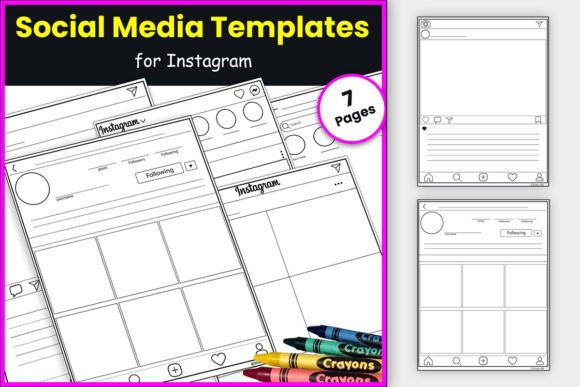
Why integrate Social Media Templates for Classroom activities? The answer lies in relevance and engagement. Students are already fluent in the syntax of social media—hashtags, captions, and visual storytelling. By co-opting this familiar format, educators can lower the barrier to entry for complex topics. This approach supports a variety of learning styles, particularly visual and kinesthetic learners who may struggle with traditional text-heavy assessments. Furthermore, it prepares students for a future where digital communication and personal branding are key components of professional success. Using these templates is a strategic decision to meet students where they are, guiding them toward where they need to be academically.
Practical Applications Across the Curriculum
The versatility of Social Media Templates for Classroom implementation is one of its strongest assets. These resources are not limited to a single subject; they serve as a blank canvas for demonstrating mastery in diverse fields. Below are specific, high-impact ways to deploy these templates to elevate the learning experience:
1. Historical Perspectives and Landmarks
History often feels distant to students. By using Social Media Templates for Classroom history projects, students can "post" as historical figures or document significant landmarks. Imagine a student creating a profile for Cleopatra or posting a "photo" of the Great Wall of China with a caption explaining its strategic importance. This method encourages students to synthesize information and present it through the lens of a specific persona, deepening their empathy and understanding of historical context.
2. Visualizing STEM Concepts
Mathematics and science are often abstract. Social Media Templates for Classroom STEM activities allow students to create visual representations of complex theories. A student might create an infographic-style post explaining the water cycle or a step-by-step "tutorial" on solving a quadratic equation. This forces the learner to distill complex information into digestible, visual chunks—a critical skill in modern communication.
3. Literary Analysis and Vocabulary
Literature comes alive when students can inhabit it. Using Social Media Templates for Classroom English assignments, students can illustrate scenes from a book's setting or create a "comment section" debate between two opposing characters. For vocabulary, students can depict a term not just by definition, but by creating a scene that embodies the word's perspective. This shifts learning from rote memorization to contextual application.
4. Collaborative Engagement and Icebreakers
The beginning of a school year sets the tone for the months ahead. Social Media Templates for Classroom introductions are an excellent icebreaker. Students can create "back-to-school" posts introducing themselves, their hobbies, or their summer highlights. This builds community and allows students to practice positive digital citizenship in a safe, moderated environment. Furthermore, encouraging students to write constructive comments on each other's work fosters a culture of peer-to-peer feedback and collaborative engagement.
Planning and Implementation: A Thoughtful Approach
While the novelty of these templates is high, their effectiveness depends on intentional planning. Do not treat Social Media Templates for Classroom use as "busy work" or a mere reward for good behavior. To achieve long-term educational value, consider the following strategic steps:
- Define the Learning Outcome: Before distributing the template, ask: What specific skill or knowledge should the student demonstrate? Is it persuasive writing, scientific labeling, or historical analysis?
- Establish Digital Citizenship Norms: Even in a simulated environment, use this as an opportunity to teach respectful communication, the importance of privacy, and the impact of words online.
- Scaffold the Activity: For younger students (elementary level), provide sentence starters or specific hashtags to use. For older students (high school), challenge them to create their own hashtags and engage in a mock comment section debate.
- Integration vs. Isolation: These templates work best when integrated into a larger unit of study. Use them as a formative assessment or a creative summarizer rather than a standalone lesson.
Avoiding Pitfalls: Context and Goals
The primary risk in adopting any new educational trend is implementation without context. Using Social Media Templates for Classroom activities simply because they are "fun" can dilute their impact and waste instructional time. If the activity does not align with a standard or a specific skill, it becomes a distraction rather than a tool.
Additionally, educators must be mindful of the social-emotional climate of their classroom. While these templates encourage interaction, they must be monitored to ensure that comments remain constructive. The goal is to simulate the best aspects of social media—community, creativity, and sharing—while mitigating the potential for negativity. Ensure that the "audience" for these posts is clearly defined and that the boundaries of the assignment are explicit.
Long-Term Value and Branding
Beyond immediate academic gains, Social Media Templates for Classroom use prepares students for the real-world application of personal branding. In the modern workforce, the ability to present information attractively and concisely is invaluable. By practicing with these templates, students learn about layout, visual hierarchy, and the power of a compelling caption. These are not just "school skills"; they are life skills that translate directly to future marketing, communication, and entrepreneurial endeavors.
Conclusion
Ultimately, Social Media Templates for Classroom environments offer a bridge between the digital world students inhabit and the academic rigor educators demand. When used strategically, they ignite engagement, foster creativity, and provide a dynamic medium for assessment. By moving beyond random application and embracing a goal-oriented approach, educators can transform a simple Instagram-style template into a powerful engine for learning and growth. Unleash the possibilities, and watch as your students not only learn the material but learn to present it to the world with confidence.